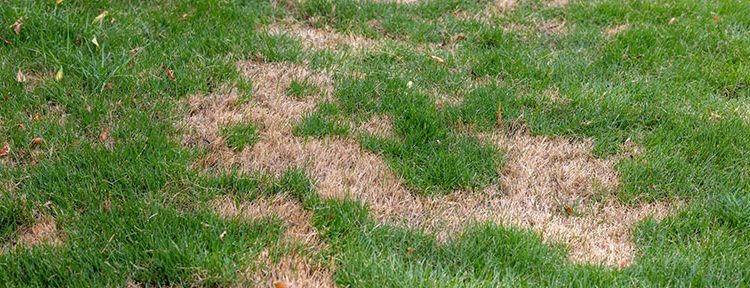
Of all the problems you can have with your lawn, I’ve found disease to be the most complex. Prevention, diagnosis, treatment are all complicated by the sheer number, causes and nature of these diseases. Certainly, my brief discussion here is only meant to be an introduction to the topic.
The disease dilemma is that you can do absolutely everything you’re supposed to, a regimen of fertilizing, consistent watering and proper mowing and still have a disgraceful lawn. It’s not fair. It’s probably no consolation to know you aren’t to blame. But with this microscopic enemy, you can easily get blindsided. Fungi spores of various kinds can be dormant in your turf waiting for just the right conditions to multiply. They only need two things, a susceptible host and a conducive environment. So, if the variety of grass you have is particularly vulnerable to a certain fungus and the conditions are optimal for this pathogen to multiply, you may be shocked to have your lawn, that was looking beautiful in early June, full of unsightly brown patches by mid July. The good news is that, unlike grub damage, your lawn will usually recover from a fugal disease.
Though there are many turf diseases, the ones I’ve seen most are dollar spot and summer patch. These happen when we have the combination of hot and wet weather. Of course, it can be caused as easily when you are supplying the water during hot spells. You should avoid watering late in the day so the lawn doesn’t stay damp all night and water less frequently. In the summer, soaking your turf with a half inch of water twice a week is better than a daily dampening.
It’s not a simple matter to combat these diseases. At best you can suppress the symptoms. You will not be able to eradicate it all together. Applying a fungicide every two weeks may give your lawn a fighting chance for recovery. Better yet, if you know you have disease prone turf, start applying monthly prevention applications in late April or early May.
I hope this overview gives you a little understanding of what I think is the most challenging of turf problems.
Related Articles